In 1896, William Thompson, the first Baron Kelvin, wrote a letter to the founder of the aeronautical society. He stated explicitly, "I have not the smallest molecule of faith in aerial navigation, other than ballooning." To Kelvin, the 19th-century scientist who defined the laws of thermodynamics, established the concept of absolute zero, and for whom the Kelvin scale is named, the laws of physics dictated that a machine heavier than air could never fly. In other words, to the guy who wrote the book on physics, it wasn't "unlikely" or "difficult," it was an impossible waste of time.
Seven years later, two bicycle mechanics from Ohio, who probably didn't know enough high-level physics to realize they shouldn't try, flew over the dunes at Kitty Hawk.
History is littered with barriers built by the smartest people in the room. We just don't know which barriers will eventually amount to "we hadn't figured it out yet," even when the defense is "it violates the fundamental laws of physics." Nikola Tesla was mocked by his own physics professor who called designs for his AC motor (the very technology that powers the entire world today) an "impossible perpetual motion machine."
A sub 4-minute mile was a biological death sentence according to doctors and experts, until Roger Bannister ran it in 1954. Yet, just as the world was realizing that biological "laws" were sometimes things we just hadn't figured out how to do yet, the music world was cementing its own. In 1955, a landmark study codified a dogma that would last for generations: the "fact" that adults cannot learn perfect pitch.
Patient Zero
To find "Patient Zero" of this infection, we have to go back to the mid-20th century. Between 1937 and 1955, researcher Albert Bachem published a series of seminal papers that would define the field of pitch perception for nearly a century. The very definition of absolute pitch can be traced back to him: the ability to identify or reproduce a musical note without any external reference. Bachem was also the first to formalize the concept of tone chroma, the invariant of a pitch irrespective of timbre or octave.
Nevertheless, Bachem's work was constrained by the limitations and expectations of his time. His famous 1 in 10,000 statistic, published in his 1955 study Absolute Pitch, was subsequently cited as if it were biological law, but it wouldn't meet the rigors of today's scientific community. He didn't conduct a massive dragnet of the population or test random people, he only evaluated 103 people who self-identified as "possessors." This textbook selection bias is the equivalent of estimating how many people have 20/20 vision by surveying the people currently sitting in an optometrist's waiting room and assuming the rest of the population is blind.
After observing his cohort of 103 people, Bachem also wrote that the ability was "acquired spontaneously" and "not acquired through practice." To a scientist, saying something is "spontaneous" is a polite way of saying "we don't know how to do this on purpose." But for the next 70 years, this single leap of logic anchored a skepticism that effectively prevented serious adult-training studies from being proposed, funded, or published.
Circular Logic
In 1993, the myth was solidified as "scientific fact." Researchers Takeuchi and Hulse published a landmark meta-analysis of historical perfect pitch studies stating unequivocally:
There are no documented cases of adults learning absolute pitch.
This observation served as the final word for a generation of music educators. People didn't feel the need to ask why there were no documented cases and accepted the "fact" as a biological barrier. It wasn't because thousands of adults had tried and failed in labs. Rather, nobody was trying because it was a "fact" that it was not possible. If the scientific consensus says a skill is a genetic superpower, no one is going to give you a grant to try and teach it. It was a perfect self-fulfilling prophecy, and the absence of evidence became a wall that was erroneously mistaken for "evidence of absence."
Chipping at the Wall
A crack finally began to appear in the wall in 2013 when cognitive scientist Stephen Van Hedger started to question whether perfect pitch is an immutable trait as we'd been led to believe. The logic was simple: if a skill can be deliberately altered when it is already stabilized, at the very least it isn't "fixed."
In his fascinating 2013 "boil the frog" experiment, Van Hedger took bonafide perfect pitch possessors and exposed them to music that gradually shifted flat. After the first fifteen minutes, the music, which started perfectly in tune, was shifted flat at a rate of about two cents per minute, much too slow for even a master musician to detect. By the end of the session, participants had been listening to music that was a full third of a semitone flat for nearly an hour.
Immediately after listening to the detuned music, these absolute pitch possessors' pitch recognition was measured relative to the detuned music. Every single participant showed a statistically significant drift, identifying the flat notes as "in-tune" according to their perfect pitch perception.
If the perceptual ability can drift in response to stimulus, it isn't a frozen genetic trait, full stop. This begged another question: If you can alter the perception for someone who is already identified as a possessor, can you establish the perception for someone who isn't?
In 2019, Van Hedger put 6 adults through an intensive training program. The training was designed to jam the analytical brain and counter solving trials using relative pitch. After 8 weeks, two participants, known as S2 and S5, achieved accuracy and speed levels indistinguishable from lifelong perfect pitch possessors. S5, a non-musician, explicitly reported that the notes took on "unique perceptual qualities," describing a newfound "feeling" for the notes that hadn't existed before the training.
When Van Hedger brought S2 and S5 back for follow-up tests months later, their ability had persisted. To disprove the statement "all swans are white," you only need one black swan. S2 and S5 were both black swans.
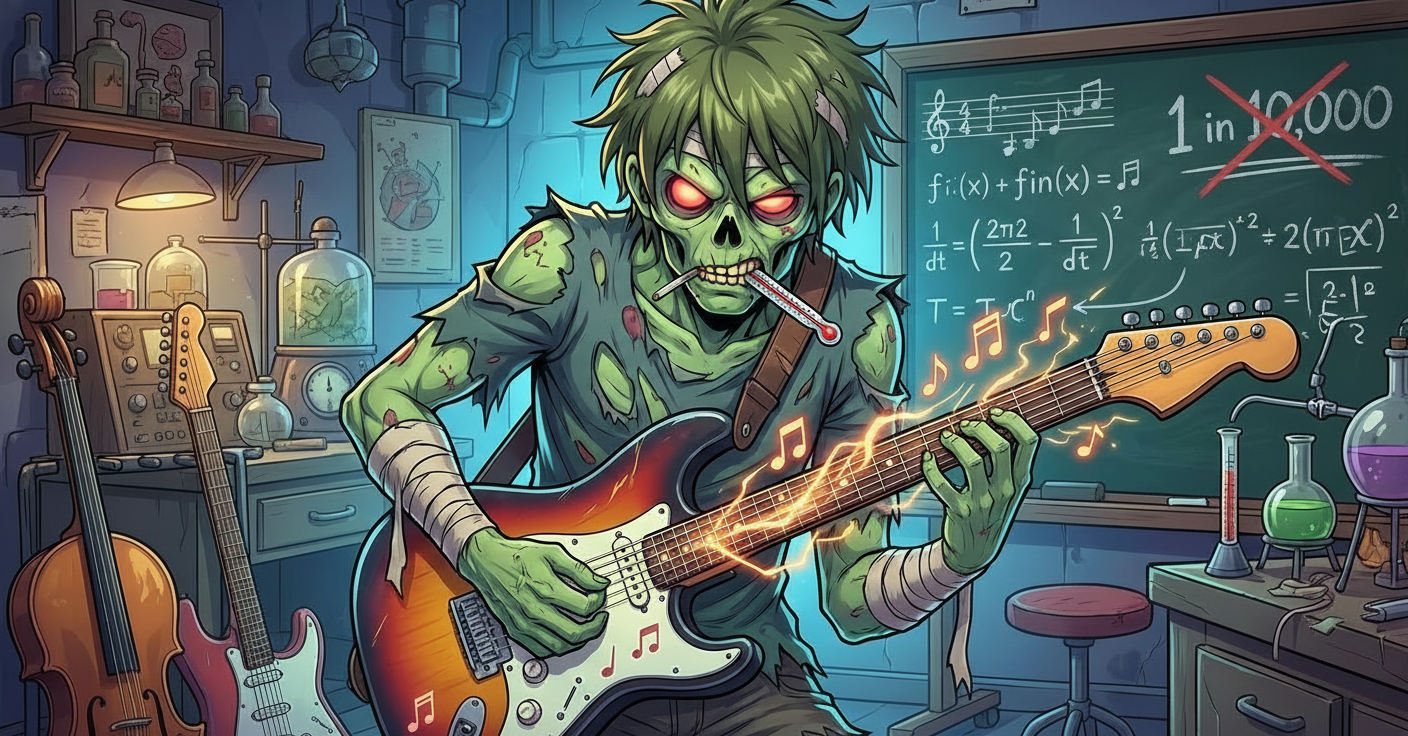
Musical Chairs Zombies!
The zombie myth of "unlearnability" has been repeatedly and incontrovertibly disproven by a plethora of evidence, yet it refuses to die. In the public consciousness, absolute pitch is still generally treated as an immutable genetic trait. Learned perfect pitch has become the "No True Scotsman" fallacy of the musical world, resulting in increasingly narrow definitions of "true" perfect pitch being conjured specifically to exclude evidence that contradicts deeply entrenched beliefs.
This binary framing is fundamentally problematic and renders almost all learning progress invisible. Through a binary lens there is no relevant difference between someone who makes a single mistake out of thousands of trials and someone who guesses randomly with an 8% success rate.
The "1 in 10,000" zombie statistic exacerbates the zombie myth by providing the idea of a fixed biological ratio. Even though research has repeatedly shown this specific number is indefensible, the deeper issue is that any fixed ratio, by definition, strips away agency. If the frequency of something is viewed as a constant of nature, then training is conceptually impossible because it can't be influenced by behavior. In short, the public subconsciously adopted a definition of perfect pitch that excludes the very possibility of learning by choice.
A 2025 systematic review of absolute pitch phenotyping confirms that this rigid, binary view is out of step with observable reality. Pitch perception is a wide array of measurable abilities. By mapping these different skill levels, researchers have shown that pitch perception exists on a broad spectrum, ranging from basic frequency detection to high-resolution recognition abilities typically referred to as perfect pitch.
The Future of "Fact"
If we look at the trajectory of recent studies, the "fact" of the next century might ironically prove a common "unlearnable" defense correct: "If you learned perfect pitch, it's because you already had it." It is increasingly looking like the human brain is natively wired for absolute pitch, but through a process called selective attention, most of us simply learn to filter it out. In other words, it could be that almost everyone in this argument is right.
During early development, our brains cull neural connections that aren't used to convey important information. In non-tonal languages like English, the exact frequency of a word doesn't change its meaning. Pitch information is instead used to convey more complex concepts learned later in life like context or emotion which increases the probability of absolute pitch information getting filtered out early as "noise." In contrast, learning tonal languages like Mandarin, where the word for "mother" (mā) becomes "scold" (mà) simply by changing the pitch while speaking the word, treats pitch information as a primary linguistic building block, increasing the probability of developing absolute pitch "spontaneously."
Evidence of this latent "superpower" is already appearing. In his 2024 "earworm" study, researcher Matt Evans found that when random non-musicians sang songs stuck in their heads, 44.7% sang the exact original key, and nearly 70% were within one semitone. This suggests you likely already have absolute pitch information recorded in your brain, but you might not recognize it as such or know the names of the pitches you remember. As researcher James Schmidt concluded in his 2025 systematic review:
A further reason for the rarity of AP could simply be the lack of extensive appropriate training. I then discuss implicit AP, which seems to be possessed by most, even nonmusicians. Implicit AP refers to the ability to identify pitches absolutely at a more unconscious level but the inability to verbally label them. The review then considers growing evidence against the notion that AP is essentially unlearnable without the right genetic endowments and/or early music education.
The story of perfect pitch "fact" is really the story of neuroplasticity and that your brain is a dynamic system that prioritizes what you choose to pay attention to. Sometimes, unlocking the door really just means realizing it was never closed in the first place.