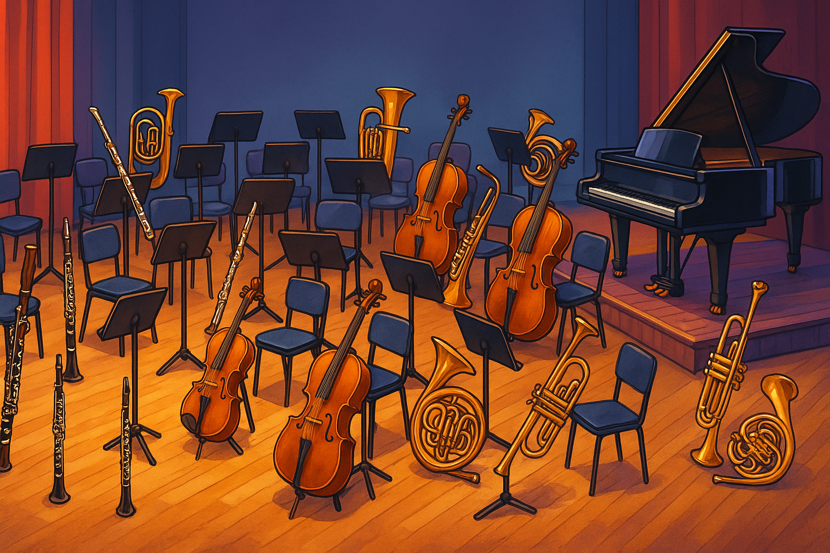
Eventual support for multiple timbres has always been built into HarmoniQ at its core, but for the sake of simplicity, HarmoniQ originally included just a single piano timbre. And though many users reached their perfect pitch goals training on just piano, HarmoniQ recently evolved from simple piano sounds into a small orchestra of 15 different timbres.
It would be perfectly natural to ask:
Do I actually need all of that to learn perfect pitch? Why can't I learn with just one timbre?
Short answer: you can absolutely learn perfect pitch with a single timbre, and the core of perfect pitch is still chroma recognition. Training with multiple timbres is about generalization: it makes your pitch categories stronger, more universal, and increases the chances of success because you're more resistant to some very common failure modes.
What Research Really Does With Timbre
If you look closely at modern training studies that convinced the field that adults can learn perfect pitch, there's a pattern around timbre that's easy to miss:
Take Van Hedger et al. (2019), one of the first widely cited studies to show adults reaching "genuine" AP performance after training. Their post‑training tests weren't limited to a single keyboard sound. Participants were tested across eight different timbres spanning seven octaves, far beyond what they'd trained on, specifically to rule out "they just memorized this sound on this instrument" as an explanation.
Wong et al. (2019) went a step further and made timbre a design variable. Across three experiments, they trained adults on different combinations of octaves and timbres, then measured how well learning generalized to untrained ranges and instruments. When they included multiple octaves and timbres in training (Experiments 1 and 3), learners generalized better to new conditions. When they deliberately restricted training to a single octave and a single synthetic timbre in Experiment 2, pitch recognition improved, but it stuck much more to the trained space.
More recently, Bongiovanni et al. (2023) trained non‑AP musicians over four weeks and then tested whether their new absolute pitch skill survived changes in tonal context, timbre, and octave. Learners did show AP‑like generalization, but the paper's whole premise is that real absolute pitch should be robust across these manipulations, and that testing only a single timbre or octave overestimates how "universal" someone's AP really is.
A separate line of work using contingency‑learning style training has also started to look at timbre transfer. In a 2024 follow‑up summarized by Iorio et al., Henry & Schmidt report that participants trained to associate pitches with labels on a subset of timbres showed transfer to untrained timbres, and that octave generalization appears with longer training.
If you zoom out, a clear picture emerges: studies that only use limited timbres can sometimes result in learning that's narrow or stimulus‑specific. Studies that include variation across multiple timbres are the ones that best support a claim of "genuine" absolute pitch, not just "I know this sound set really well."
The research is quietly telling us: if you train across multiple timbres, you'll develop stronger pitch categories that are more likely to generalize to universal perfect pitch.
Chroma Is the Constant
Perfect pitch isn't about frequency numbers or instrument sounds. It's about chroma, the pitch "color" that stays the same when you move the note to a new octave or play it on a different instrument. Genuine AP is supposed to be invariant to three things at once: tonal context, timbre, and octave. Change the key, change the instrument, shift the register: a C♯ should still register as "C♯" to someone with solid AP.
Unfortunately, our brains will happily latch onto anything that seems to help us tell notes apart, even recording defects, background noise, or subtle differences in the rate of vibrato. If you only ever hear one carefully curated piano sample for each note, it can be hard to know for sure whether you're learning chroma or just a bundle of chroma + timbre + idiosyncrasies. For example, if your piano sample has a slightly longer ring on G♯, it's easy to mistake that for chroma. And, when you sit at a real instrument or listen to a different library, suddenly everything feels off. But, when the only thing that's consistent from trial to trial is the underlying chroma, your brain is pushed to find the invariant "color" that persists through all those surface-level differences.
Inside HarmoniQ, that's exactly why I've spread chroma training across four piano timbres and a broad set of other instruments. The repeated exposure to "same chroma, different sound" makes it much harder for your ear to lean on recording quirks and much easier to lock onto the thing that actually matters. It's like you're telling your brain:
Don't trust the instrument. Don't trust the recording. Find the chroma.
When a pure tone and a rich, noisy instrument both register as "this is F♯," you've got much better evidence that you're tracking the right thing.
Multiple Timbres Help With Relative Pitch Interference
Relative pitch is fantastic. It's also one of the biggest sources of interference when you're trying to learn perfect pitch.
Most musicians are used to processing music relationally: "this note is a major third above that one," "this chord feels like the dominant," and so on. That's great for almost everything we do musically, but it can crowd out chroma if you're not careful. An abundance of recent research suggests we all seem to have some form of absolute pitch memory, but relative pitch tends to dominate whenever it has enough structure to grab onto.
One of the most common struggles learners report is exactly this tug‑of‑war between a budding chroma intuition and a very strong habit of reasoning comparatively. Multiple timbres give you a surprisingly simple way to turn down relative pitch interference: when the instrument constantly changes, your relative pitch has more work to do because there are fewer stable cues to latch onto. As a result, it slows down, making it easier to identify and strengthen your chroma intuition. Relative pitch doesn't go away, nor should it, but it becomes less useful as a crutch in tasks that are designed to be chroma‑first.
So, Is It Necessary or Not?
No. You can learn perfect pitch from a single timbre. In fact, some of the most impactful adult training protocols began with small, tightly controlled pitch sets and limited timbral variation to keep the task focused.
But the closer you get to a "universal" sense of pitch color, the kind that holds up across instruments, octaves, and contexts, the more you run into three problems:
- Overfitting to a sound set: You think you've learned chroma, but you've really learned one particular library or recording.
- Instrument‑specific AP: Your accuracy is great on one instrument and falls apart on others, because your pitch map is entangled with timbre.
- Relative‑pitch interference: Your brain keeps trying to solve a chroma task with interval logic.
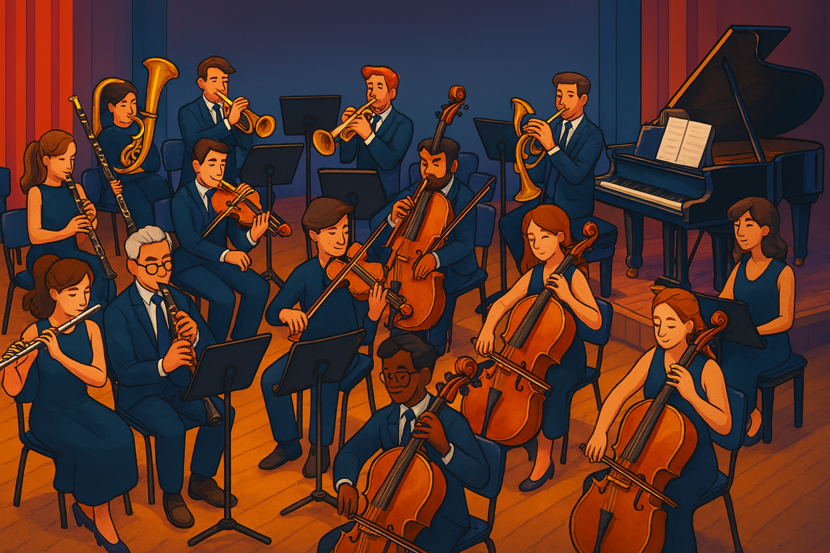
Adding multiple timbres doesn't magically teach perfect pitch on its own, but it does stack the odds in your favor. It pushes your ear toward the invariants, makes logical shortcuts less reliable, and makes it easier to notice and trust the "this just is F♮" feeling you're trying to cultivate. A broader palette of timbres is a natural extension to HarmoniQ's mission of making perfect pitch accessible to everyone who wants it. Perfect pitch doesn't care whether a note comes from a piano, a trumpet, or a sine wave. Your training doesn't need to either.