What do you think when you visualize what it's like to have perfect pitch?
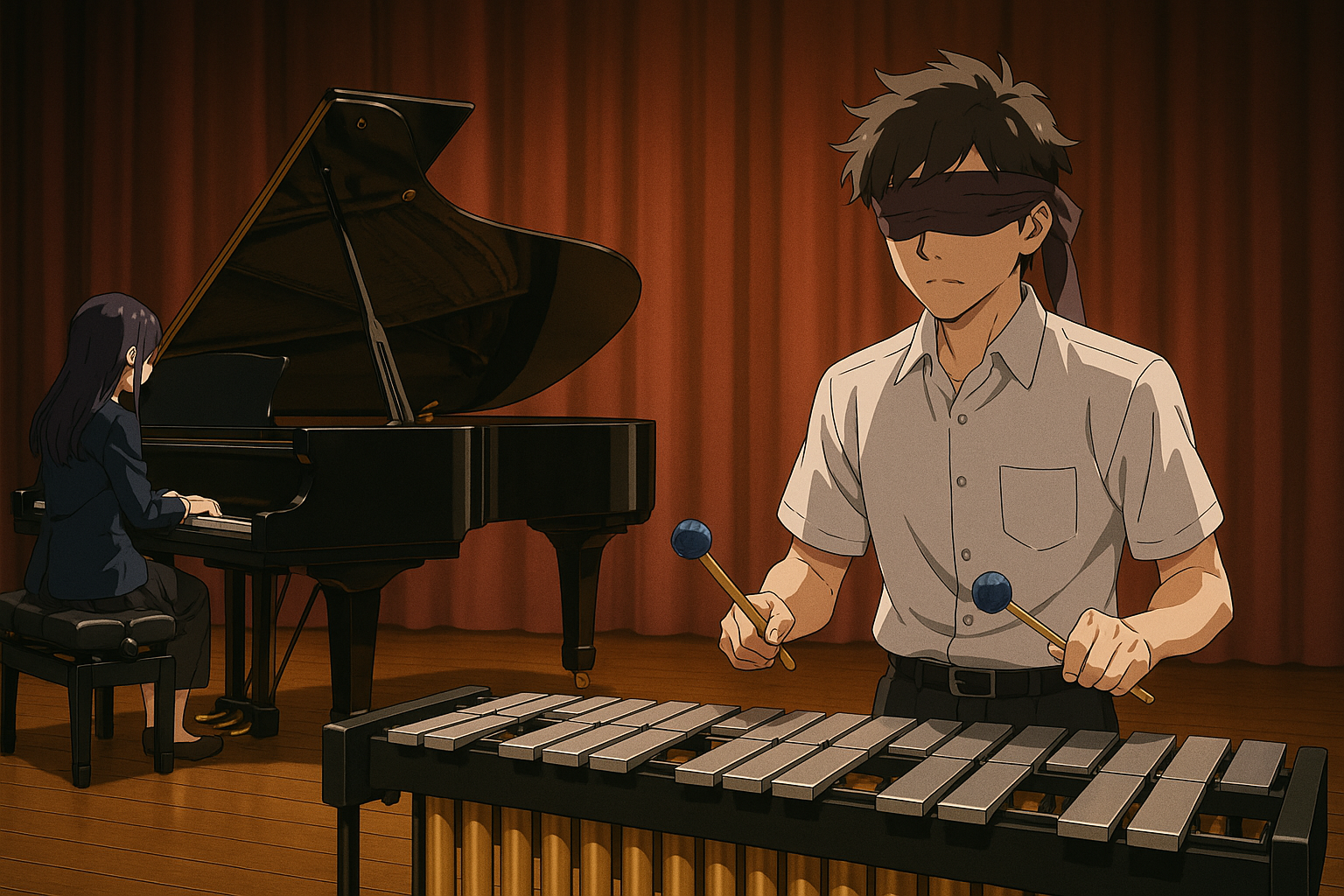
If you scroll through videos about music on Instagram long enough, you'll eventually come across videos like this one: someone sits at a piano, plays a huge, altered jazz chord, and someone else out of view of the piano identifies the entire thing instantly, root, quality, and alterations. As an added bonus, they might just launch into a blazing run on a vibraphone that's faster than all but the most skilled mallet players. This is exactly the kind of thing people visualize when they imagine what having "perfect pitch" is like.
Yes, the person in the video certainly has absolute pitch. But the thing they're doing is not "hear chord → AP activates → answer achieved." If not AP, then what's actually happening when someone can nail any 9-note chord in half a second?
What's actually happening is a blend of multiple musical processes firing at once: relative pitch, chord-structure hearing, color recognition, theory reasoning, AP tagging, pattern memory, and intuition. And whichever combination happens to be easiest in that exact moment is the one the brain will use.
In fact, most of the real work in this video is not AP at all. This is the part that often surprises people: the skills required to instantly name complex chords are mostly relative-pitch skills. AP shows up, but it doesn't do the job alone, and in many cases it isn't even the primary contributor.
Let's break down what's really happening.
Hearing the Root is A Relative Skill, Even if You Have AP
When a dense chord hits your ear, the first thing your brain does is look for the gravitational center. You might feel the root before you name anything else. Maybe you can hum it back. Even people with AP experience this root-finding step as a feeling, not a naming process. This step is almost entirely relative pitch. The perception of the root comes from the interval structure inside the chord, how the overtones stack, how dissonances resolve, and how the chord "leans" toward a particular pitch center.
If you tried to do this using only AP, it would look like this:
- Identify each individual note by name.
- Convert those notes into intervals.
- Figure out which note makes the stack make sense.
- Conclude the root.
This works, but it's absurdly slow and completely unnatural in real-time music. With trained relative pitch, identifying the root of a chord, not including its name, is immediate.
Hearing the Quality
Major. Minor. Diminished. Augmented. Sus2. Sus4.
These are also not AP tasks. These are shape-recognition tasks. You hear the contour, the distance between notes, and the color of the intervals.
Someone with AP could do this by naming all the notes, turning them into distances, and reasoning their way into "okay, that's minor." But again, that's slow and useless in practice, and more importantly, that's not how musicians actually hear music. When you've trained your ear, quality recognition can become completely intuitive. You don't think "root, minor third, perfect fifth"; you think "that's minor" because your perception of the chord is direct.
Hearing Alterations and Extensions
This is often a part people typically think is pure AP: "He can hear every note, so of course he knows it's a ♯11!" But that's oversimplified in practice. Take a ♯9, for example. A ♯9 is the same pitch as a minor third, the same note name if you're relying on AP alone. You cannot know whether it's functioning as a minor third or a sharp ninth until you understand the root, the chord quality, whether a major third is present or implied, and how the upper extensions relate to the underlying harmony.
That requires music theory, not AP. Imagine trying to do all of that with only perfect pitch, even when the root is already identified:
"The notes are C, B♭, E, G, D♯, F♯… the root is C, D♯ could be a minor third or ♯9… F♯ could be a diminished fifth or ♯11… let me reconstruct the structure… C, E, G, B♭… ok, that's a dominant seventh… what's left again?"
This is absolutely doable, and people with AP often can do it analytically. It's like solving a puzzle rather than perceiving a color instantly. By contrast, with sufficiently advanced RP, you don't need to calculate anything. When you hear the colors of the ♯11 and ♯9, you know intuitively. These tensions have recognizable flavors long before you attach names to them. Extensions and alterations feel as intuitive as major vs minor, and that feeling is much faster than assembling a chord out of raw AP note IDs.
Naming the Root: Now AP
Here's where AP finally gets its moment. Once you've established the pitch of the root, AP can tell you what note it is. That's the final piece that gives you the chord name, not just the harmonic identity. That's not to say that AP can't contribute elsewhere. You might identify the root and quality with RP, have a specific altered note jump out to your AP because it's perceptually distinct, then instantly recognize what that pitch means in the context of the chord you've already identified. Either way, it's the combination of AP, RP, and knowledge of music theory that makes labeling chords like this instantaneous.
Without AP you might be able to say, "this is a dominant 13 chord with a ♯11," but that's just not as impressive as immediately saying "G13♯11." The difference is subtle, and that small gap sometimes ends up with someone attributing the whole experience to AP.

Musicians with both AP and RP at the highest levels don't switch between modes, and they don't decide "turn on AP for this" or "this one's RP's job." The brain intuitively does whatever is easiest without you having to think. It's as easy as recognizing a color, and you just know. This also explains something people rarely talk about: you don't always know which skill you just used. Did your AP tag the individual notes first and your brain assembled the structure from there? Or did your RP decode the color of the chord before AP even had a chance to fire? Did theory resolve an ambiguity your ear wasn't consciously tracking? Or was it some combination of all three? Most musicians couldn't tell you which process came first because all of it happens together, and none of it feels separate. Once both systems are mature, the distinction stops mattering. "Perfect pitch" and "relative pitch" aren't buttons you press; they're perceptual habits that kick in together whenever they're useful.
Whether you're developing absolute pitch with HarmoniQ or strengthening your relative pitch skills, remember that these abilities work together. Some of the most skilled musicians seamlessly blend both, creating a rich and intuitive understanding of music that goes far beyond simply naming notes.